
One of the biggest misunderstandings people have about consistency is that they think a lack of consistency means laziness or lack of discipline. Most of the time, that’s not true. Usually, something deeper is getting in the way. If we want to create lasting change, we have to stop judging ourselves and start getting curious.
Why does consistency feel so difficult? Especially when it comes to practices like Tai Chi, Qigong, meditation, or anything meant to support your well-being.
If you say, “I want to feel happier, so I’m going to practice Tai Chi,” that sounds simple enough. But what happens on the days when part of you doesn’t want to feel better? What about the days when you’re overwhelmed, disconnected, emotionally exhausted, and you are self-sabotaging?
Those are the days that matter most, instead of forcing yourself through guilt, it helps to ask deeper questions:
What is not working in my life right now? What doesn’t feel good in my body? Why am I tired of carrying these feelings?
And then ask yourself honestly:
If nothing changes, where will I be in six months? If your answer is that you will still be in the same place, but with more tension, less energy, and feeling even more disconnected.
Then ask yourself:
If I practiced consistently for six months, even imperfectly, what could be different? The key is to stay honest and realistic, because on the days when you don’t feel like practicing, your “why” is what carries you.
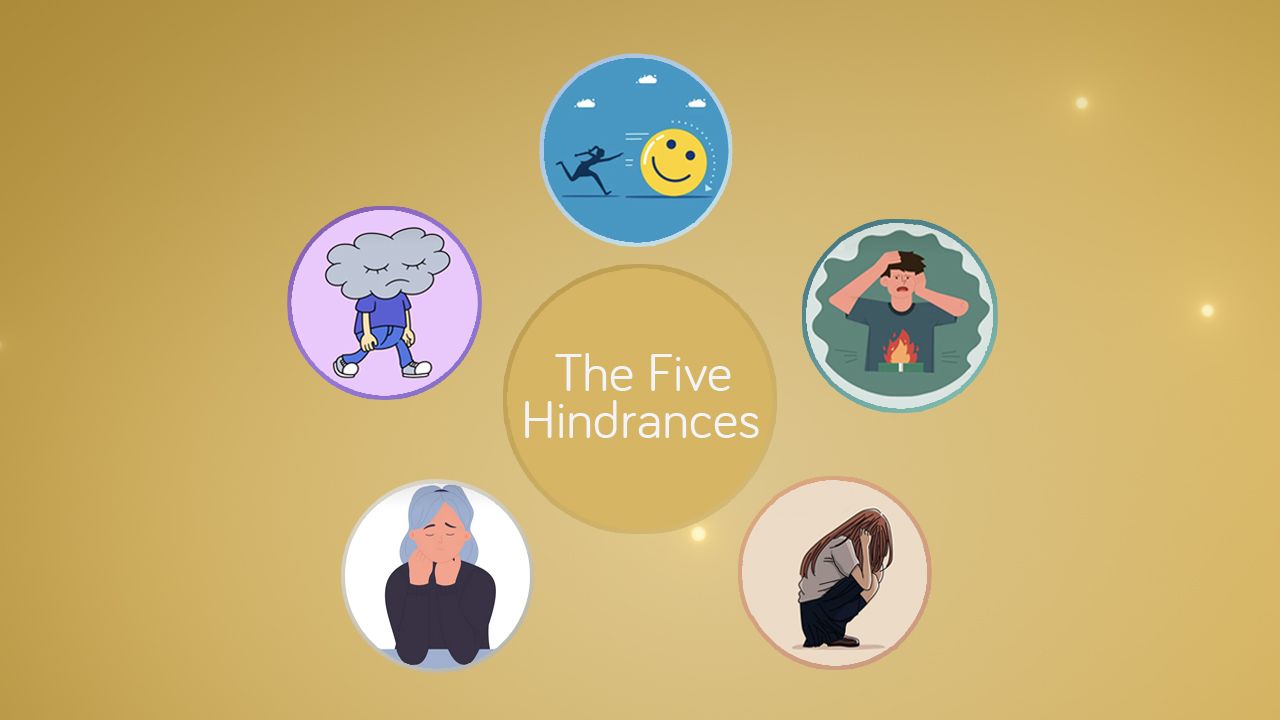
The Five Ways We Self-Sabotage and the five hindrances from Zen and mindfulness practice.
These five patterns are deeply human. Everyone experiences them.
- Desire
This is when you simply want to do something else. You’d rather watch a movie, scroll your phone, eat snacks, or do anything more immediately enjoyable than Tai Chi. This is where remembering your deeper reason matters. Why are you practicing? Sometimes the solution is not forcing yourself into an hour-long session. Sometimes it’s saying:
'I’ll just do five minutes' and remember that something is always better than nothing.
- Aversion
Some days practice feels boring. Some days your body feels stiff, heavy, emotional, restless, or uncomfortable. We don’t enjoy practicing every single day, and that’s normal. On those days, it helps to listen to your body instead of fighting it. Maybe instead of a stronger Tai Chi practice, you do gentle Qigong stretching. Maybe you move more softly. Maybe you simply breathe and reconnect. Consistency does not mean pushing yourself aggressively every day.
- Sloth and Torpor
This is the heavy, sluggish feeling where you have no energy and everything feels like too much effort. Ironically, Tai Chi is often the thing that would give you energy, but low energy convinces you not to begin. The important thing is simply to start. Usually once you begin, your energy shifts. And even if you stop after a few minutes, it still counts because you interrupted the pattern.
- Restlessness
This is the “I’ll do it later” mind. Your attention is scattered. You keep doing other tasks first. The day disappears. One of the simplest solutions is structure. Practice at the same time every day whenever possible. Remove the constant decision-making. Instead of asking: 'When should I practice today?'
It becomes: 'This is my Tai Chi time.' Everything else can happen afterward.
- Doubt
'Is this even working?'
'Is it worth it?'
'What’s the point?'
This one catches many people because transformation is often subtle at first. Small repeated actions create deep change over time, but while you are inside the process, it can be hard to see.You do not need motivation every day. You do not need to feel inspired. You simply need a reason that feels true enough to carry you through the difficult days.
Consistency is an underappreciated form of intentional magic disguised as mundane doing.
Real transformation looks like tiny repeated actions. A few minutes of practice, one conscious breath, a walk or one decision to begin again.
A journey of a thousand miles begins with one step but what is most important is the next step and the next.
An old Chinese saying is that dripping water can penetrate stone. This means that small repeated effort becomes powerful over time.
So move slowly if you need to, Just don’t stand still. Doing something is always better than doing nothing.
(The next 30-Day mindfulness challenge is scheduled for July 2026)
Stay connected with news and updates!
Join our mailing list to receive the latest news and updates from our team.
Don't worry, your information will not be shared.
We hate SPAM. We will never sell your information, for any reason.
